Gender Alignment and Divergence in Christmas Purchase Criteria
Christmas shopping in Germany involves a complex set of trade-offs, as consumers weigh practical considerations such as cost and product quality against experiential factors including convenience and service. Understanding which criteria carry the most weight, and whether those priorities differ meaningfully by gender, is central to effective retail and communications planning ahead of the festive season.
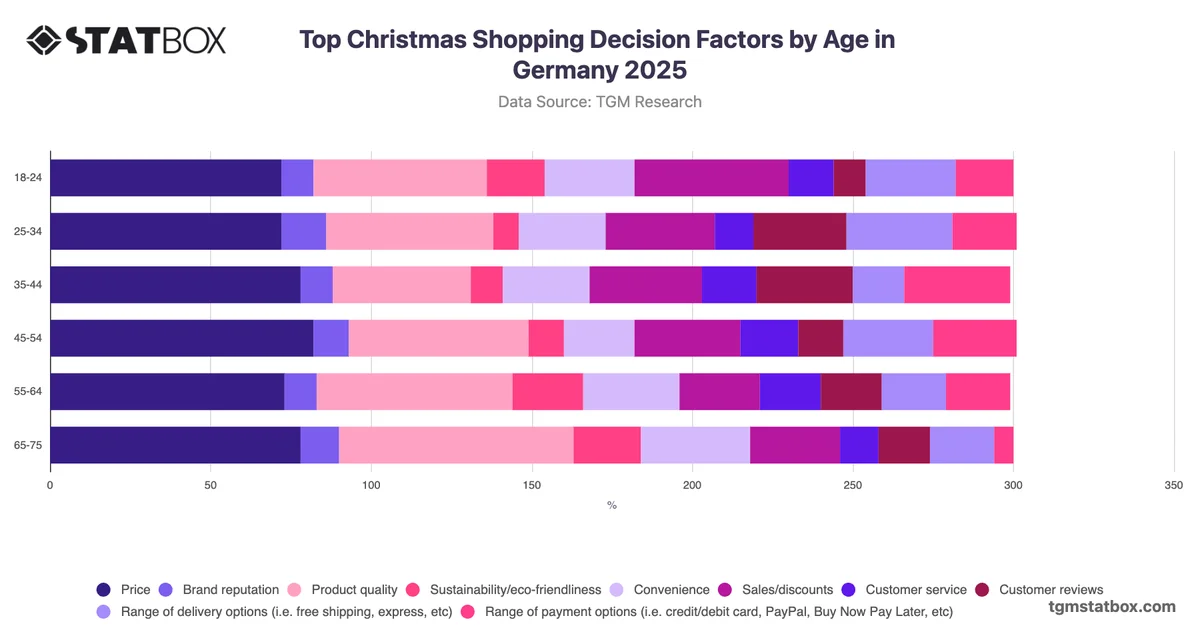
The most analytically significant pattern across Christmas shopping decision factors in Germany is the broad consistency between male and female consumers rather than pronounced divergence. Price and product quality rank as the top two considerations for both groups, at 77% and 59% for men and 75% and 55% for women respectively, indicating that value-driven evaluation is a near-universal priority regardless of gender. Moderate differences appear in sustainability, where women score four percentage points higher than men, and in customer service, where men score five points higher than women, yet neither gap is large enough to indicate meaningfully distinct consumer segments. This pattern of weak gender differentiation suggests that Christmas retail strategies built around price competitiveness and product quality will resonate broadly across both groups. Where segmentation may add value is in testing whether sustainability-oriented messaging generates stronger engagement among female shoppers, given the directional, if modest, difference observed.