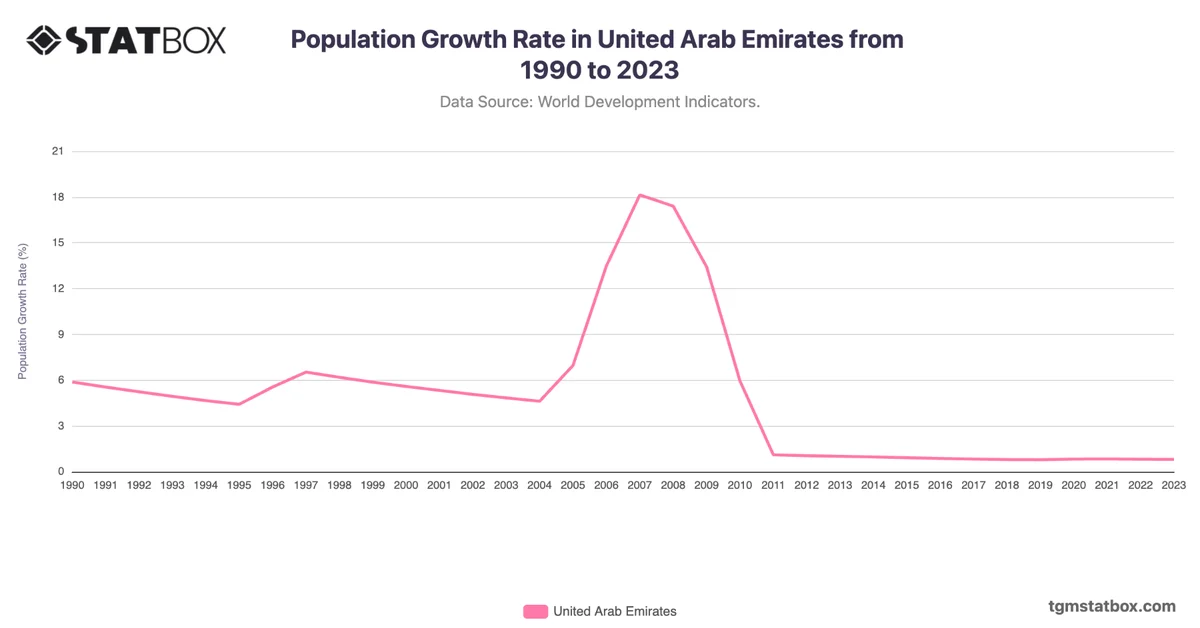
The United Arab Emirates (UAE) saw a rapid increase in population density from 1990 to 2021, rising from 27 people per square kilometer in 1990 to 132 by 2021. This significant growth can be attributed to the country’s economic expansion, driven primarily by the oil and construction sectors. The population density grew notably from the mid-2000s, with an acceleration evident from 60 in 2005 to 119 in 2010, largely fueled by foreign labor influx and urban development, especially in Dubai and Abu Dhabi.
From 2011 onwards, growth stabilized, with only incremental increases, reaching 132 by 2021. This leveling reflects a maturing economy with gradual adjustments in migration policies and a shift toward sustainable development and innovation. These shifts have contributed to a stable, high-density population while balancing urban expansion with strategic planning.
From 2011 onwards, growth stabilized, with only incremental increases, reaching 132 by 2021. This leveling reflects a maturing economy with gradual adjustments in migration policies and a shift toward sustainable development and innovation. These shifts have contributed to a stable, high-density population while balancing urban expansion with strategic planning.
Explore related charts to gain a better understanding of UAE’s median age shifts, UAE’s mortality rate trend, Military personnel proportion in UAE.