Chart

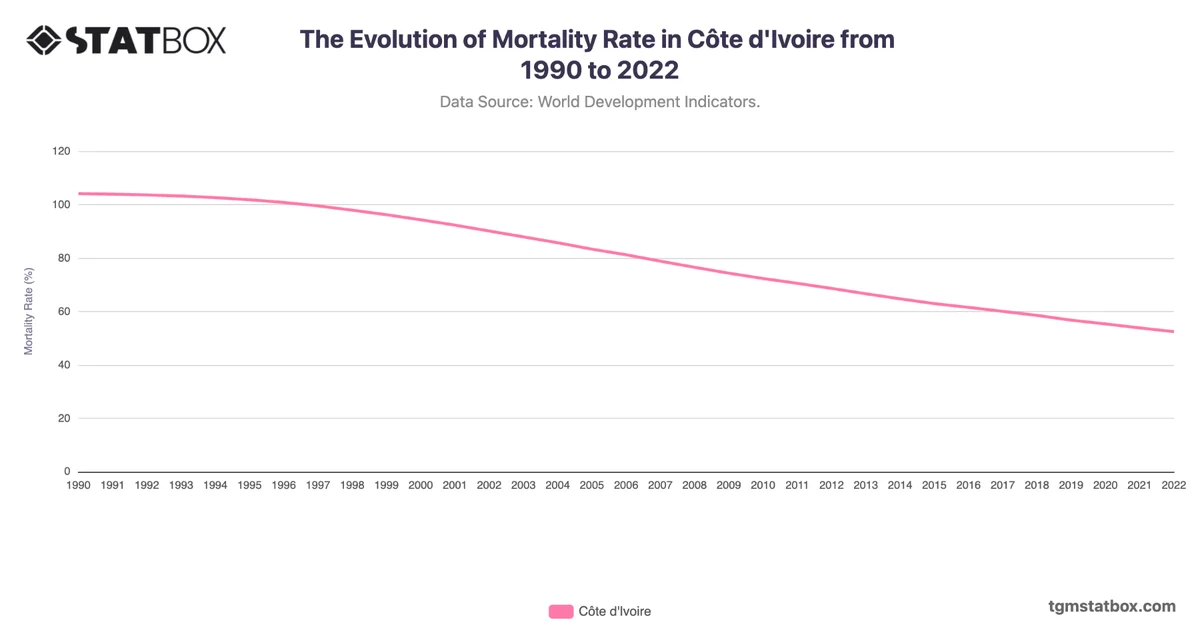
The Changing Death Rate in Côte d'Ivoire from 1990 to 2022

The Changing Death Rate in Côte d'Ivoire from 1990 to 2022

Share the statistic on social media channels or embed the statistic in your website using "Embed Code", where available.

Share chart

Embed chart
Select Citation

Cite this statistic and select one of the following formats: APA, Chicago, Harvard, MLA & Bluebook


  • APA
  • Chicago
  • Harvard
  • MLA
  • Bluebook
  • IEEE
TGM StatBox. (2024). The Changing Death Rate in Côte d'Ivoire from 1990 to 2022. TGM StatBox.
Insights

Key Takeaways

Côte d'Ivoire has witnessed a steady decline in its death rate over the past three decades, from 13.9 deaths per 1,000 people in 1990 to 8.8 in 2022. This decline can be attributed to improvements in healthcare access, disease prevention programs, and socioeconomic development. The country made significant strides in reducing mortality from infectious diseases and improving maternal and child health. Despite the downward trend, the death rate experienced minor fluctuations due to political instability and public health challenges, particularly around the early 2000s. The recent increase in 2020, partially due to the pandemic, disrupted the long-term positive trend. Nevertheless, Côte d'Ivoire's improving healthcare infrastructure continues to contribute to a lower mortality rate.

For a deeper dive into the topic, explore fertility rate trends in Côte d’Ivoire, Côte d’Ivoire’s population numbers, urbanization rate in Côte d’Ivoire.

AI-powered chart insight: This summary is automatically generated to help you understand the chart at a glance. It is intended as an overview; view the full chart and underlying data for complete context.

Charts library

Further Recommended Ivory Coast Statistics

Statbox vector
The briefing
New data, in your inbox

Consumer insights, data stories and product updates as we publish them. No other mail, and one click to leave.

Roughly two emails a month.

Research services
Have a question our newsroom hasn't answered? Ask it directly.

Our team can run the study behind the story — in 60+ countries, on your question, with the data belonging to you.