Pet ownership creates a wide range of recurring expenses, covering everyday essentials, services and products that support an animal’s health and wellbeing.
For pet brands, understanding how much consumers are comfortable spending each month can help put demand into context. It can also support decisions around pricing, product positioning and the types of offers that are likely to fit different consumer budgets.
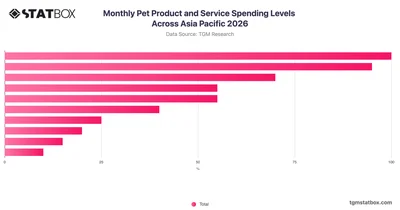
TGM StatBox data looks at monthly spending on pet products and services among pet owners across APAC, providing a clearer picture of the spending level where the largest share of consumers is concentrated.
The data shows that pet spending is most commonly concentrated at the lower end of the monthly spending range.
According to TGM APAC Pet Care Insights 2026, 39% of pet owners across APAC spend between $11 and $40 per month on pet products and services, making this the largest spending group.
The finding suggests that a substantial part of the pet care market is built around relatively moderate monthly budgets.
For brands, this can be an important consideration when developing product portfolios. Consumers within this spending range can still purchase across multiple pet care needs, but affordability and perceived value are likely to play an important role in how those budgets are allocated.
Monthly spending can also help brands think beyond a single product purchase. Pet owners can divide their budgets across food, healthcare, accessories & grooming and other services, meaning different categories are competing for a share of the same monthly wallet.
As a result, understanding spending levels can give businesses useful context when evaluating price points, bundle strategies and opportunities to encourage repeat purchases.
The largest spending segment does not necessarily represent one single type of pet owner or one uniform set of needs.
Brands can get a more useful picture by combining spending data with other variables such as pet type, category preferences, purchase frequency and shopping behavior.
For example, the same monthly budget can translate into very different purchase patterns depending on whether consumers prioritize premium food, veterinary care, grooming or accessories.
This makes spending data particularly useful when assessing how products should be positioned within a broader portfolio. Entry-level and mid-priced options can help brands reach consumers with more limited monthly budgets, while premium products can be targeted more selectively where willingness to spend is higher.
Spending levels can also support market planning by giving commercial teams a clearer sense of how much room consumers have within their monthly pet care budgets.
However, monthly expenditure alone does not explain why consumers choose certain products, where they shop or which factors influence their decisions.
For brands assessing market opportunities, spending is only part of the equation. Explore pet ownership across APAC to understand where pet-owning audiences are most concentrated across the region.
TGM StatBox allows teams to explore pet care statistics in more detail by selecting the data points most relevant to their market and business needs, including pet spending, shopping behavior, product preferences and purchase drivers.
The TGM Global Pet Care Insights 2026 study is based on a large-scale quantitative survey conducted across 7 countries, targeting a representative sample of adults aged 18 to 55+. Designed to explore the changing trends and consumer behaviors shaping pet care in 2026, the survey focuses on five key areas: nutrition, health & veterinary care, owners & lifestyle, services & accessories, and pet technology.

Findings from our data, highlighting consumer behaviour, preferences, and market signals across global markets.
Follow global economic trends and market signals through clear visual stories.
The latest launches and updates from TGM StatBox.
TGM StatBox's data and infographics across Asia Pacific markets.
Consumer insights, data stories and product updates as we publish them. No other mail, and one click to leave.
Roughly two emails a month.
Our team can run the study behind the story — in 60+ countries, on your question, with the data belonging to you.
Type at least two characters to search.