Chart

Trends in Working Age Population Percentage in United Arab Emirates from 1990 to 2022

Trends in Working Age Population Percentage in United Arab Emirates from 1990 to 2022

Share the statistic on social media channels or embed the statistic in your website using "Embed Code", where available.

Share chart

Embed chart
Select Citation

Cite this statistic and select one of the following formats: APA, Chicago, Harvard, MLA & Bluebook


  • APA
  • Chicago
  • Harvard
  • MLA
  • Bluebook
  • IEEE
TGM StatBox. (2024). Trends in Working Age Population Percentage in United Arab Emirates from 1990 to 2022. TGM StatBox.
Insights

Key Takeaways

The UAE’s working-age population showed a significant upward trend from 1990 to 2009, beginning at 69.3% and reaching a peak of 86.1% in 2010. This steady growth reflects the country’s rapid economic development, fueled largely by the influx of foreign labor to support construction, infrastructure, and energy sectors. Post-2010, the working-age population began a gradual decline, influenced by policies aimed at nationalizing the workforce and economic diversification strategies. By 2022, the percentage settled at 82.9%, indicating a stable yet slightly declining trend as the UAE continues to adapt to changing labor demands and population demographics.

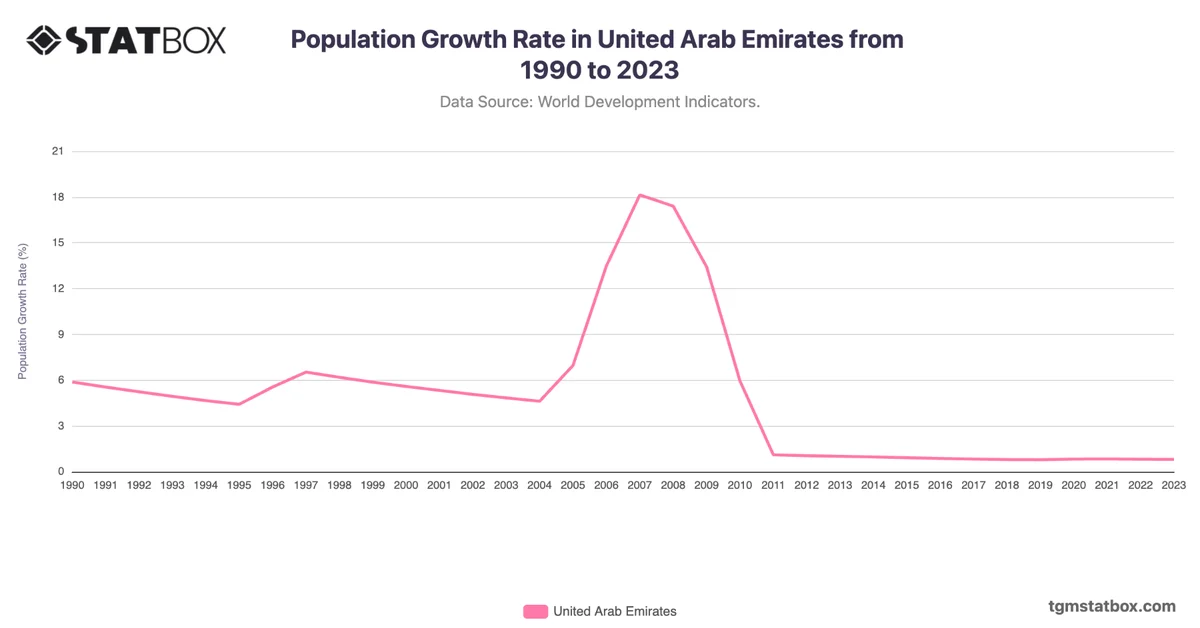
Explore related charts to gain a better understanding of UAE’s median age shifts, UAE population growth rate, UAE population density.
AI-powered chart insight: This summary is automatically generated to help you understand the chart at a glance. It is intended as an overview; view the full chart and underlying data for complete context.

Related report

Would You Like to Know More?
Explore Our UAE Report

Charts library

Further Recommended UAE Statistics

Statbox vector
The briefing
New data, in your inbox

Consumer insights, data stories and product updates as we publish them. No other mail, and one click to leave.

Roughly two emails a month.

Research services
Have a question our newsroom hasn't answered? Ask it directly.

Our team can run the study behind the story — in 60+ countries, on your question, with the data belonging to you.