Pet technology is expanding fast across APAC, but adoption doesn't look the same for every pet's owner. For brands building or marketing pet tech products, knowing which tools cat owners and dog owners actually use, and what they say they're interested in can big advatanges to product and channel strategy.
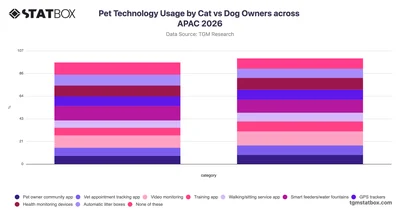
TGM StatBox data compares current pet technology usage between cat owners and dog owners across APAC, and one gap stands out clearly: training apps.
TGM Pet Care Insights on Technology & Innovation 2026 shows that smart feeders and water fountains are the most-used pet tech products for both cat and dog owners across APAC. This points to convenience-driven, routine-care tools as the common entry point into pet tech, regardless of the type of pet owned.
The picture changes when it comes to training apps. Dog owners report notably higher usage than cat owners, a gap that reflects how training fits into daily care very differently depending on the animal.
No account? Sign up free, new members get 3 premium charts to view.
This suggests that once tech usage moves past everyday convenience, adoption starts to follow the specific needs of the animal rather than general enthusiasm for pet tech. A cat owner may see little value in a training app built around obedience routines, while a dog owner may not prioritize tools designed for more independent, low-supervision pets.
Read more: How much pet owners spend monthly can add more context on budget allocation for high-tech pet gadgets.
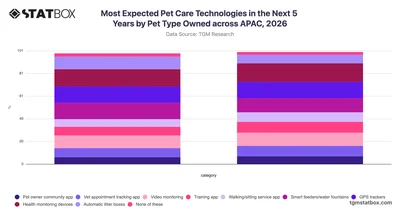
While current usage splits along practical lines, expectations for the future look more unified. Pet owners' outlook on emerging technology shows that health monitoring devices rank as the top technology both cat and dog owners expect to become common within the next five years, regardless of pet type.
This points to a shared priority underneath the current behavioral gap: owners may differ in which tools they use day-to-day, but they align on wanting more visibility into their pet's health. For brands, this suggests health monitoring is a safer long-term bet than tools built around a single pet type, since it speaks to a need both segments already recognize.
Smart feeders and water fountains succeed because they solve a routine problem relevant to nearly any pet. Brands entering the category with a new device may find faster traction leading with this kind of universal, low-friction use case.
The training app gap shows that pet type is a meaningful segmentation variable for both product design and marketing. A single "pet owners" messaging strategy risks underselling products that are genuinely more relevant to one group than another.
At the same time, shared expectations around health monitoring suggest brands don't need to segment everything. Some innovation areas are worth building, and messaging around the full pet owner base rather than one pet type alone.
Brands may also need to look beyond current usage to understand how much owners are willing to spend on pet tech, or which channels influence their purchase decisions.
That is where TGM StatBox can support more targeted consumer research. Explore StatBox and let your team select the specific data points they need by market, audience and business question.
The TGM Global Pet Care Insights 2026 study is based on a large-scale quantitative survey conducted across 7 countries, targeting a representative sample of adults aged 18 to 55+. Designed to explore the changing trends and consumer behaviors shaping pet care in 2026, the survey focuses on five key areas: nutrition, health & veterinary care, owners & lifestyle, services & accessories, and pet technology.
Findings from our data, highlighting consumer behaviour, preferences, and market signals across global markets.
Follow global economic trends and market signals through clear visual stories.
The latest launches and updates from TGM StatBox.
TGM StatBox's pet care across the world behavior data and infographics across Asia Pacific markets.
Consumer insights, data stories and product updates as we publish them. No other mail, and one click to leave.
Roughly two emails a month.
Our team can run the study behind the story — in 60+ countries, on your question, with the data belonging to you.
Type at least two characters to search.