When people say they are worried about the environment, they are not all worrying about the same thing. Some think first about extreme weather, while others are more concerned about polluted air, damage to nature or resources running out.
That is what makes this ranking interesting. TGM Research surveyed 18,985 respondents across 34 countries and asked global respondents to choose the one environmental or climate issue that concerns them most. The answers show which problems rise to the top when people have to choose just one.
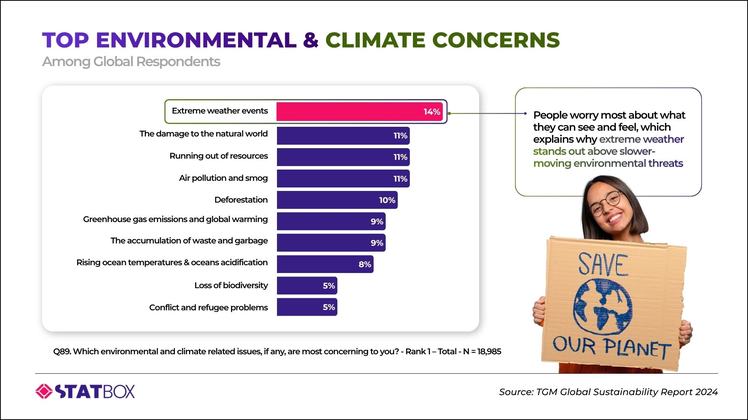
Extreme weather is the leading environmental concern
Extreme weather stands out at 14%, ahead of damage to the natural world, resource depletion and air pollution at 11% each.
The gap is not huge, which is important. People are concerned about several environmental pressures at once rather than focusing on one issue alone. Still, extreme weather has one advantage in public awareness: it is highly visible and easier to connect with everyday life.
Heatwaves, floods, storms and wildfires are events people can see, experience and associate with disruption around them. Other environmental problems, such as biodiversity loss or ocean acidification, often develop more gradually and can feel further removed from daily experience.
So, why does extreme weather worry people most?
One likely reason is that extreme weather increasingly feels less like a distant environmental issue and more like something that can affect homes, transport, food supply, work and personal safety.
The World Meteorological Organization's State of the Global Climate 2025 reported that 2015–2025 were the hottest 11 years on record. During 2025, intense heat, heavy rainfall and tropical cyclones caused major disruption across different parts of the world, affecting millions of people and generating billions of dollars in losses.
That immediacy matters. People do not need to understand every part of climate science to understand what a flooded neighborhood, an unusually long heatwave or a severe storm means to daily life. Extreme weather turns an environmental issue into a lived experience.
The concern also reflects a wider long-term risk. The World Economic Forum's Global Risks Report 2026 places extreme weather as the most severe global risk over the next ten years, even though geopolitical and economic issues currently compete more strongly for short-term attention.
So the 14% in TGM's data does more than show which environmental issue receives the most concern. It also suggests that people may respond most strongly to environmental problems when the consequences become visible, immediate and personally understandable.
Environmental concern goes beyond global warming
Another interesting pattern is that greenhouse gas emissions and global warming rank at 9%, below extreme weather, air pollution and resource depletion.
The ranking suggests that people do not necessarily think about environmental problems through climate terminology alone. More tangible consequences such as polluted air, disappearing resources or damaged ecosystems can carry their own importance.
That concern also reflects real environmental pressures. WHO describes air pollution as the leading environmental health risk factor, associated with around 6.6 million deaths globally each year.
Resource pressure is another example. UNEP reports that global natural-resource extraction has tripled over the past five decades and, without major changes in consumption and production, could rise another 60% by 2060 compared with 2020 levels.
So, how do these environmental concerns connect to the economy?
Environmental issues become economic issues when they affect the systems people and businesses rely on: infrastructure, resources, production and human health.
Extreme weather provides the clearest example. Swiss Re Institute estimates that natural catastrophes caused around USD 220 billion in global economic losses in 2025, with wildfires and severe storms among the major loss drivers. Only USD 107 billion of those losses were insured.
The economic effect extends beyond damaged buildings. Severe events disrupt transport and production, require reconstruction spending, increase insurance exposure and place additional pressure on public budgets.
The other concerns in TGM's data enter the economy through different routes. Resource depletion affects the availability and cost of materials, while air pollution carries consequences for health and productivity. Damage to forests and ecosystems also matters because many industries depend directly on natural resources and stable environmental conditions.
In that sense, the chart is not only showing what people worry about. Many of the issues receiving public attention are also pressures that already carry an economic cost.
How do these pressures reach business decisions?
Businesses operate inside the same environmental and economic systems, so these pressures gradually appear in everyday commercial decisions. Some common cases include:
Public concern adds another layer. The TGM data suggests that people often connect environmental problems with visible consequences such as extreme weather, pollution and resource pressure, rather than thinking only in broad terms such as “global warming.”
That distinction matters when looking at consumer attitudes.
Environmental concern does not automatically mean people will pay more or change their behavior with sustainable practice, yet it gives some indication of which environmental problems already feel real and personally relevant.
Knowing the specific concern helps businesses decide where environmental efforts need to focus. For example:
The same understanding also helps businesses explain environmental actions in terms consumers already recognize, rather than relying on broad sustainability language.
It can also shape environmental claims and campaign messages. A message about “protecting the planet” may feel too general when consumers are actually thinking about plastic waste, polluted air or extreme weather. More specific concerns give businesses a clearer basis for choosing which environmental issues to address and how to communicate those actions without overstating what they achieve.
Over time, economic exposure and public expectations also interact. Changes in regulation, resource availability, consumer habits and physical climate conditions gradually influence the environment in which companies make decisions.
Looking at environmental concern alongside those wider pressures therefore gives a more complete picture than treating sustainability as a single consumer trend.
If you want to look deeper into how sustainability attitudes are developing, explore more sustainability charts on TGM StatBox. These insights can help strengthen environmental planning, refine consumer communication and support more informed long-term decisions.
 Premium
Level of Interest in Adopting Sustainable Practices and Climate Change Issues Globally 2025
Premium
Level of Interest in Adopting Sustainable Practices and Climate Change Issues Globally 2025
 Premium
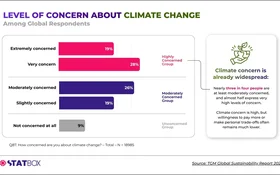
Level of Concern About Climate Change Among Global Respondents 2025
Premium
Level of Concern About Climate Change Among Global Respondents 2025
 Premium
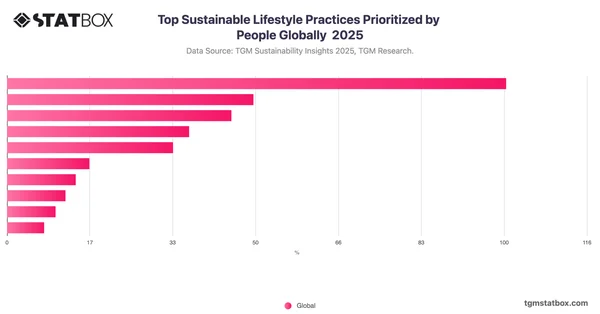
Top Sustainable Lifestyle Practices Prioritized by People Globally 2025
Premium
Top Sustainable Lifestyle Practices Prioritized by People Globally 2025
 Premium
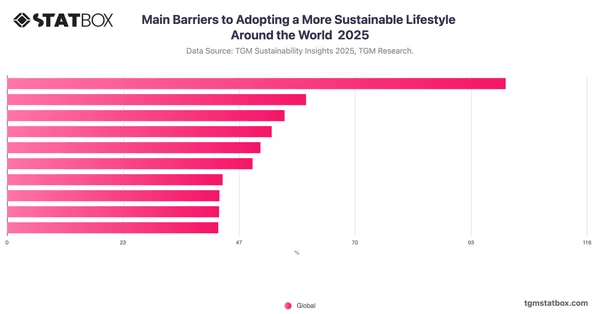
Main Barriers to Adopting a More Sustainable Lifestyle Around the World 2025
Premium
Main Barriers to Adopting a More Sustainable Lifestyle Around the World 2025
Methodology
The TGM Global Sustainability Report 2024 is based on a large-scale quantitative survey conducted across 34 countries, targeting a representative sample of adults aged 18 to 55+. Designed to uncover how people think, feel, and act on sustainability issues, the survey explores sustainable behaviors, climate concerns, everyday eco-practices, and barriers to action for 2024.
According to the TGM Sustainability Insights 2025 report, this chart shows the environmental and climate issues global respondents are most concerned about, with extreme weather leading ahead of nature loss, resource depletion and air pollution.
Findings from our data, highlighting consumer behaviour, preferences, and market signals across global markets.
Follow global economic trends and market signals through clear visual stories.
The latest launches and updates from TGM StatBox.
TGM StatBox's global sustainability attitudes & behavior data and infographics across Global markets.
Consumer insights, data stories and product updates as we publish them. No other mail, and one click to leave.
Roughly two emails a month.
Our team can run the study behind the story — in 60+ countries, on your question, with the data belonging to you.
Type at least two characters to search.