Reduce, Reuse and Recycle sounds like one of the most familiar ideas in sustainability. Yet knowing individual actions such as recycling is different from recognizing the 3R concept as a whole.
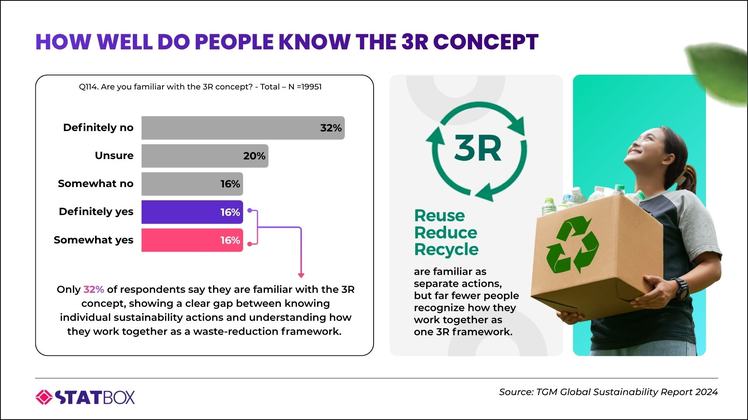
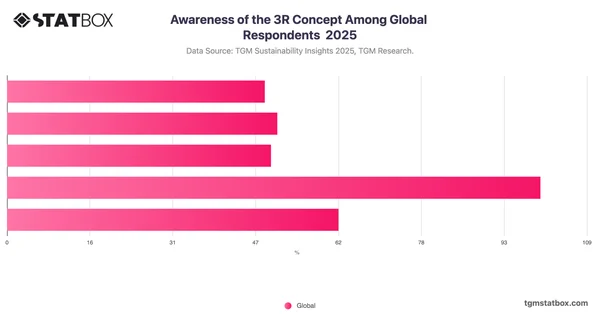
According to the TGM Global Sustainability Report, published in 2025, based on a survey of 20,107 respondents across 35 countries, only 32% say they are familiar with the 3R concept, while 48% say they are not familiar. The remaining respondents are unsure. The finding points to an interesting gap: people can encounter sustainable actions in everyday life without clearly recognizing the framework that connects them.
People practice the three Rs separately without knowing the 3R framework
The awareness gap becomes easier to understand when we look at everyday routines. Many sustainable actions already sit inside normal household behavior, yet people do not always label them as part of the 3R concept.
Examples include:
The actions themselves are simple and familiar. The framework that connects them is less visible. Someone might already reduce household waste or reuse products regularly while thinking of those choices as saving money, avoiding waste or being practical rather than following a sustainability framework.
That helps explain why familiarity with individual practices can be much stronger than familiarity with the term “3R concept.” People can understand the actions before they recognize the framework behind them.
The 20% who are unsure adds another clue. Some respondents likely recognize Reduce, Reuse and Recycle as separate ideas but do not feel confident identifying them together as one concept.
So, what is the idea behind the 3Rs?
The 3Rs are more than three separate environmental actions. Their order reflects a simple waste hierarchy: reduce what becomes waste first, reuse products and materials for as long as possible, then recycle what can no longer be reused.
That order is important because each step deals with waste at a different stage.
This logic is also reflected in formal waste-management frameworks. The EU waste hierarchy places prevention first, followed by preparing for reuse and then recycling, with disposal positioned as the last option. UNEP follows a similar circularity approach, where reducing resource use comes before processes such as reuse, repair and recycling.
Seen this way, the bigger idea behind the 3Rs is prevention first, not recycling first.
Why does 3R awareness deserve attention?
3R awareness deserves attention because knowing the framework changes how people think about waste. When the sequence is unclear, recycling easily becomes the most visible environmental action, while the first priority receives less attention: reducing waste before it is created. The 3R concept puts prevention first, then reuse, with recycling coming later for materials that remain.
That distinction is important for consumers as well as wider waste systems. Recycling deals with waste after a product or material has already been used, while reduction addresses the problem earlier by limiting unnecessary consumption and waste generation. Understanding the full 3R sequence therefore shifts the focus from “How do we recycle more?” to “How do we create less waste in the first place?”
The World Bank’s What a Waste 3.0 reports that the world generated about 2.56 billion tonnes of municipal solid waste in 2022. Under a business-as-usual scenario, annual waste could reach 3.86 billion tonnes by 2050, around 50% higher. Around one-third of global waste is also still uncollected or openly dumped.
That creates an important contradiction. Protecting the environment has become a familiar message in public campaigns, schools, brands and everyday conversations, yet the amount of waste generated worldwide continues to rise. The problem is therefore not simply a lack of environmental attention. There is still a gap between caring about the environment and understanding which actions reduce pressure at the source.
Recycling is a good example. People can recycle regularly and still contribute to growing waste volumes if consumption and disposal continue increasing. The 3R framework brings the focus further upstream: environmental progress starts with creating less waste, then keeping products in use for longer, before relying on recycling for what remains. That is why awareness of the full framework is useful, especially when waste remains a growing global challenge.
So, what does the 3R familiarity rate help businesses understand?
Only around 32 in every 100 respondents say they are familiar with the 3R concept. The awareness gap becomes relevant when businesses want consumers to follow the 3Rs. Before asking people to reduce, reuse or recycle, companies need to make those actions possible through the way products and services are designed.
The starting point is Reduce. The 3R framework asks businesses to look at how much waste enters the system before thinking about how to deal with it afterward.
That order also changes how businesses guide consumers. A sustainability message becomes clearer when it follows the same sequence instead of focusing only on recycling.
A personal-care brand gives a clear example of how the full 3R sequence works in practice.
The consumer message can then follow the same order: buy with less packaging, keep and refill the container, then recycle it at the end of its useful life.
In this example, the brand is not asking consumers to “follow the 3Rs” as an abstract sustainability idea. It builds Reduce, Reuse and Recycle into the product journey, then shows customers exactly how to take part at each stage.
The example shows why the 32% familiarity rate is useful for business strategy. When most consumers do not clearly recognize the 3R framework, businesses should not rely on the term alone. The action needs to be built into the product journey and explained in plain language.
Reduce becomes the first question: where can waste be prevented before it is created? Reuse follows by extending the life of products or packaging, while recycling deals with what remains after further use is no longer practical.
The key business insight is that 3R awareness data shows where consumer understanding starts. A low familiarity rate signals that companies need to make the hierarchy visible through both product design and consumer guidance, rather than assuming people already understand the framework.
Readers who want to look beyond awareness can explore more TGM StatBox sustainability statistics to compare what people know with how sustainability appears in their everyday behavior.
 Premium
Level of Interest in Adopting Sustainable Practices and Climate Change Issues Globally 2025
Premium
Level of Interest in Adopting Sustainable Practices and Climate Change Issues Globally 2025
 Premium
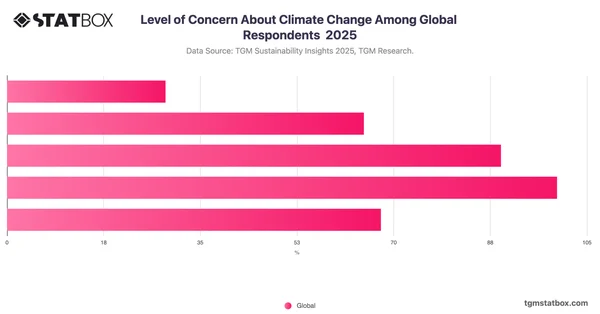
Level of Concern About Climate Change Among Global Respondents 2025
Premium
Level of Concern About Climate Change Among Global Respondents 2025
 Premium
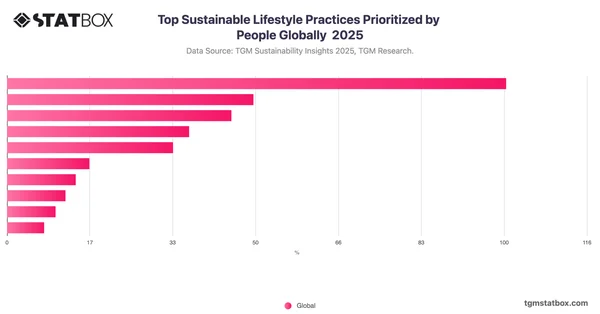
Top Sustainable Lifestyle Practices Prioritized by People Globally 2025
Premium
Top Sustainable Lifestyle Practices Prioritized by People Globally 2025
 Premium
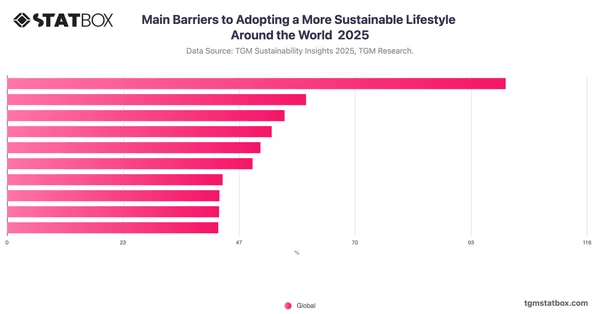
Main Barriers to Adopting a More Sustainable Lifestyle Around the World 2025
Premium
Main Barriers to Adopting a More Sustainable Lifestyle Around the World 2025
 Premium
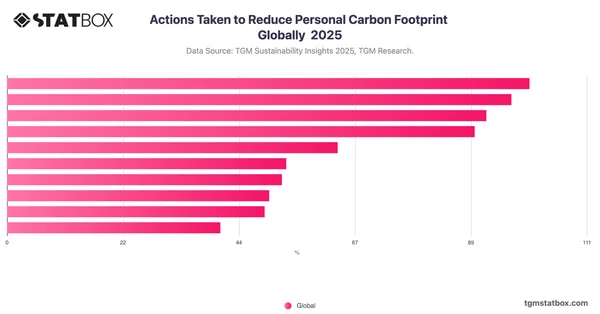
Actions Taken to Reduce Personal Carbon Footprint Globally 2025
Premium
Actions Taken to Reduce Personal Carbon Footprint Globally 2025
 Premium
Awareness of the 3R Concept Among Global Respondents 2025
Premium
Awareness of the 3R Concept Among Global Respondents 2025
Methodology
The TGM Global Sustainability Report 2024 is based on a large-scale quantitative survey conducted across 34 countries, targeting a representative sample of adults aged 18 to 55+. Designed to uncover how people think, feel, and act on sustainability issues, the survey explores sustainable behaviors, climate concerns, everyday eco-practices, and barriers to action for 2024.
Survey Methodology: online interviews (CAWI – Computer-Assisted Web Interviewing)
Sample Size: 18,985 participants
Age Groups: 18–24, 25–34, 35–44, 45–54, 55+
Country Coverage: Austria, Belgium, France, Germany, Ireland, Netherlands, Poland, Portugal, Romania, Serbia, Spain, Switzerland, Turkey, UK, Ukraine, Argentina, Brazil, Chile, Colombia, Mexico, Peru, Australia, India, Indonesia, New Zealand, Philippines, Singapore, Thailand, Vietnam, Nigeria, South Africa, Saudi Arabia, UAE, USA.
Data Weighting: Results have been weighted to reflect national demographics for accurate market representation.
According to the TGM Global Sustainability Report, published in 2025, this chart shows how familiar global respondents are with the 3R concept (Reduce, Reuse and Recycle), highlighting a clear gap between awareness of the framework and its wider role in sustainable waste management.
Findings from our data, highlighting consumer behaviour, preferences, and market signals across global markets.
Follow global economic trends and market signals through clear visual stories.
The latest launches and updates from TGM StatBox.
TGM StatBox's data and infographics across global markets.
Consumer insights, data stories and product updates as we publish them. No other mail, and one click to leave.
Roughly two emails a month.
Our team can run the study behind the story — in 60+ countries, on your question, with the data belonging to you.
Type at least two characters to search.