Consumers have always paid for speed. What has changed is how much of daily life now runs through that trade. Meals arrive instead of being cooked, rides are summoned instead of planned, and checkout takes one tap instead of a trip. In each case, the consumer is not only buying a product. They are buying back time and attention.
TGM Research's own surveys across food delivery, ride-hailing and e-commerce point to the same conclusion: convenience has become a currency in its own right. Consumers spend it, compare it and switch brands over it. But the data also shows its limits. The brands that win are the ones that pair ease with trust, reliability and a price that feels fair.
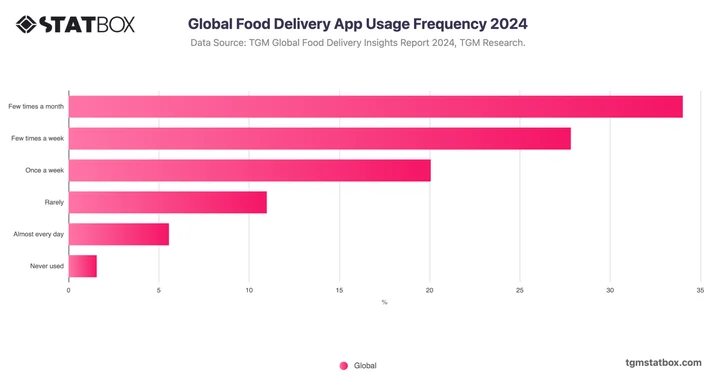
Food delivery is the clearest case of convenience turning into routine. According to the TGM Global Food Delivery Report, 53% of global users place an order at least once a week. Over a third order a few times a week or more: 28% use delivery several times a week and 6% almost every day.
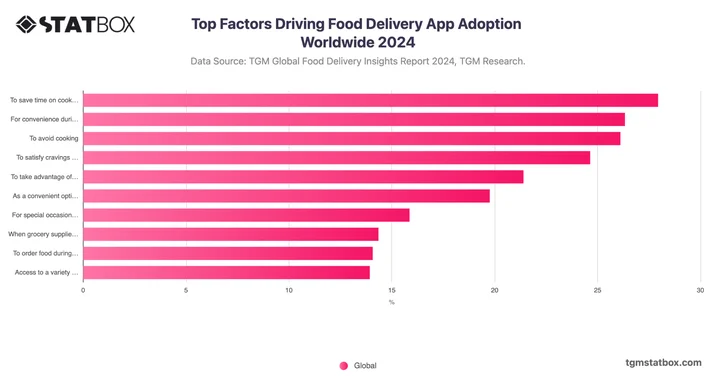
The reason is less about food than about time. 28% of users order to save time on cooking and cleaning, 26% value the convenience during busy schedules, and another 26% simply want to avoid cooking altogether. On the StatBox food delivery topic page, 27.9% say they use delivery because they lack the time or energy to cook after a busy day.
The motivation shifts with lifestyle. In APAC and Africa, convenience during busy schedules is the top driver. In Europe and LATAM, people mainly order to avoid cooking. In the Middle East, the main reason is saving time on meal prep and cleaning, and the region leads adoption overall: 51% are frequent users and 10% order daily. Europe sits at the other end, with frequent use at 21%, reflecting a stronger attachment to home-cooked meals.
For brands, this matters more than the headline number. "Convenience" means a faster weeknight in Manila, a skipped kitchen in Madrid and a cleaner home in Riyadh. One message will not land in all three.
Saving minutes is only half of what convenience delivers. The other half is removing the small worries that come with getting something done: Will the ride show up? Will I get home safely? Will the order arrive as promised?
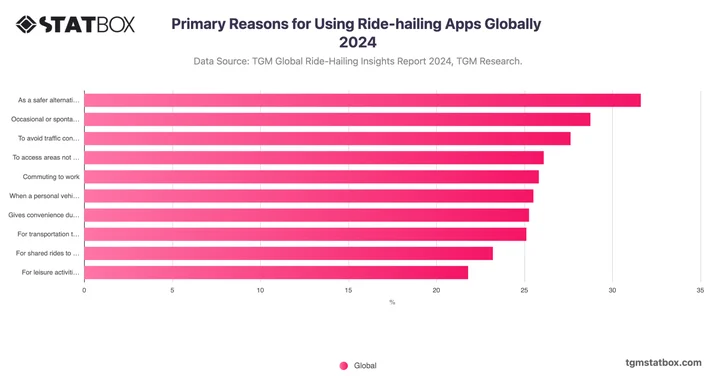
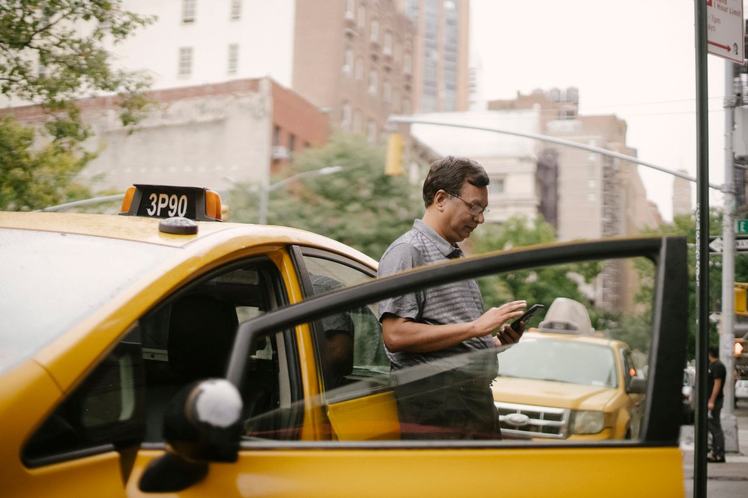
Ride-hailing shows this well. Data from TGM Global Ride-Hailing Insights 2026 (based on 19,780 respondents across 30 markets) found that 65% of consumers used a ride-hailing app in the past 12 months. Earlier data from StatBox shows why people reach for it: 31.6% use ride-hailing for safer travel at night, and 27.6% use it to avoid traffic. Around 9.8% are near-daily users (N=3,742).
The TGM Global Ride-Hailing Insights 2026 study shows ride-hailing solving different problems depending on what the city offers:
In each case, the convenience being bought is peace of mind. That is why safety now sits close to price in several regions: in Africa, safety and security features (72%) nearly match price (74%) as a choice factor, and safety is also highly valued in APAC (60%), MENA (53%) and North America (53%).
The same pattern appears in food delivery. When choosing an app, 43% put trust in the brand first, and 20% value fast order processing. Consumers want to stop thinking about whether something will work. The brand that removes that doubt wins the habit.
Convenience is valued, but it is not a blank cheque. In ride-hailing, 69% of users still rank fare as their top consideration when choosing a platform. Price gets the first ride. Safety, reliability and short wait times decide whether there is a second one.
Food delivery tells a more nuanced story. Only 9% name competitive pricing as their main reason for picking an app, far behind brand trust (43%), and price matters most in APAC, Europe and LATAM. Once delivery becomes a weekly routine, consumers seem less focused on shaving costs and more on choosing a service they can rely on without thinking.
Online shopping follows the same logic. TGM's 2026 e-commerce research across seven countries (7,077 respondents) tracks how free or faster shipping, delivery speed, easy returns and payment flexibility shape where people buy, alongside price and reviews. Convenience features now sit inside the purchase decision, not after it.
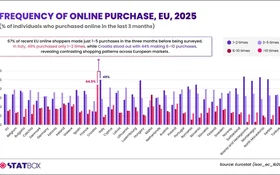
This is why online shopping keeps growing into a habit. When every order saves a trip, a queue and an hour of someone's day, the time saved becomes the real currency, and shoppers spend it by buying online more often. As our look at monthly online shopping habits across Europe shows, buying online has become a regular part of the month. Shoppers also choose where to buy with time in mind: after price, fast delivery is the factor that most often decides which store gets the order.
In the end, convenience is a mix of time saved, worry removed and value that feels fair. Brands that deliver all three will earn more than a purchase. They will earn a place in the consumer's routine.
Need the data behind your next decision? Explore the Food Delivery, Ride-hailing and E-commerce topics on TGM StatBox. Unlock only the charts you need, ready in seconds and built on TGM's own research.
From food delivery to ride-hailing, TGM data shows consumers pay for time saved, less effort and trust, and where the opportunities lie in 2027 for brands.
Methodology:
Survey Methodology: online interviews (CAWI – Computer-Assisted Web Interviewing)
TGM Global Ride-Hailing Insights 2026, 19,780 online interviews across 30 countries, ages 16–75+.
TGM E-Commerce Insights 2026: 7,077 respondents across seven countries.
TGM Global Ride-Hailing Report 2024: 3,000+ participants, age groups: 18–55+ across 34 countries.
TGM Global Food Delivery Report 2024: 7,585 respondents across 34 countries, ages 18–55+.

Findings from our data, highlighting consumer behaviour, preferences, and market signals across global markets.
Follow global economic trends and market signals through clear visual stories.
The latest launches and updates from TGM StatBox.
TGM StatBox's data and infographics across Global markets.
Consumer insights, data stories and product updates as we publish them. No other mail, and one click to leave.
Roughly two emails a month.
Our team can run the study behind the story — in 60+ countries, on your question, with the data belonging to you.
Type at least two characters to search.