Christmas 2026 will be won by the brands that understand one thing: shoppers haven't fallen out of love with the season. They've simply become more deliberate about it. They start earlier, set firmer budgets and ask harder questions about what deserves a place under the tree.
That is the clearest signal from TGM Christmas Insights 2025, our survey of more than 3,000 consumers across the USA, Canada, Germany, France, Italy and Spain. Looking back at last year's behaviors reveals how vital preparation is: consumer habits from the previous season serve as an invaluable roadmap, turning past data into a practical playbook for the critical weeks ahead.

For a growing group of shoppers, Christmas is no longer a December event. It is a two-month campaign, planned with the same care as a household budget.
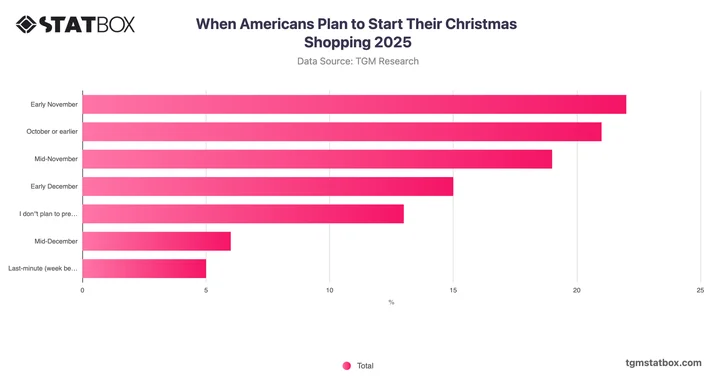
In the USA, 21% of shoppers had started buying gifts in October or earlier, and a further 22% began in early November. In other words, more than four in ten Americans were already shopping before Black Friday arrived. Germany and Canada follow the same rhythm, with 21% of shoppers in each market starting in early November.
This isn't impatience. It's risk management. Shoppers move early to spread costs across more than one pay cycle, to beat delivery cut-offs and to avoid finding the gift they wanted sold out. An early start gives them control in a season that otherwise feels expensive and rushed.
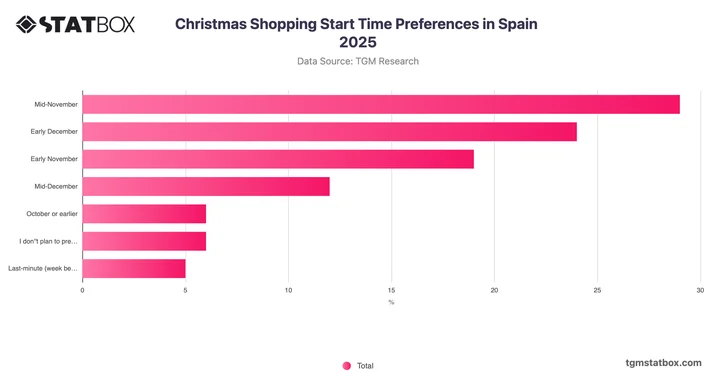
Spain is the exception that proves the rule. With gift-giving stretching to Three Kings' Day on 6 January, Spanish shoppers start later: 29% begin in mid-November and 24% in early December. Even here, men (31%) are slightly more likely than women to get going in mid-November.
Black Friday falls on 27 November this year, but for a large share of shoppers it marks the middle of the season, not the start. Brands that save their Christmas story for December will be talking to people who have already ticked off much of their list. Reward the early planner instead: price-match promises, early-delivery guarantees and gift guides that land in October and early November. In later markets such as Spain, keep enough budget for a second push in December.
Price-consciousness is not the same as bargain-hunting. Across every market with published results, price was the single biggest factor in Christmas purchase decisions. But quality came a close second almost everywhere, which tells us shoppers are not simply hunting for the cheapest option. They want to feel they paid a fair price for something worth giving.
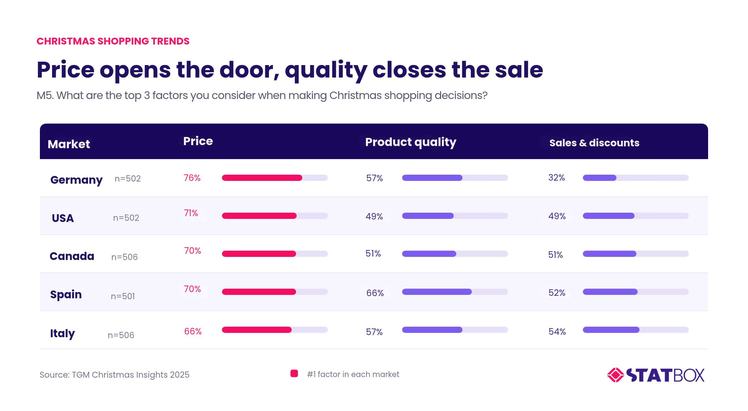
Germany is the most price-sensitive market in the study, but that doesn't mean promotions easily sway shoppers. According to the "top factors driving Christmas shopping decisions in Germany 2025", only 32% say sales and discounts influence their decisions, creating a 44-point gap between price sensitivity and promotional appeal, the widest among all markets. For German shoppers, being price-conscious is more about getting good quality at a fair price than simply hunting for bargains. Even a steep discount can sometimes make them question whether a product was worth its original price in the first place.
For Spanish shopping motivations, quality (66%) sits just four points behind price, the closest the two come anywhere. Spanish shoppers are the most willing to pay for a better gift, which fits their budgets: nearly a third (32%) plan to spend $250–$499. The question they ask isn't "is it cheap?" but "is it worth it?"
Italy flips the pattern. It is the least price-sensitive of the five markets (66%), yet the most responsive to promotions (54%), with deals almost level with quality (57%). Italian budgets are also the most modest, with 27% planning to spend under $99. Here, a well-timed offer acts less as a rescue for the stretched shopper and more as a prompt to buy: it gives people a reason to act now.
North American shoppers weigh quality and discounts exactly equally: 49% each in the USA and 51% each in Canada. They will take either route to value, the better product or the better deal, and often compare both in the same session. That makes them the hardest shoppers to win with a single message.
The common thread is that shoppers are being careful, not cutting back. The IPA's 2026 Christmas Consumer also finds that money worries haven't gone away, yet fewer people plan major cutbacks than in previous years, and gifts remain the biggest share of festive spending.
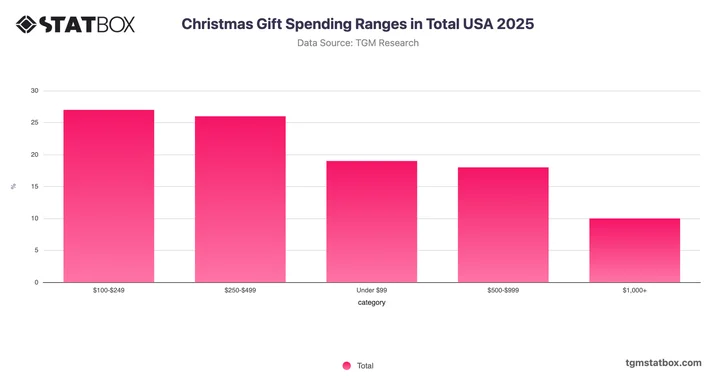
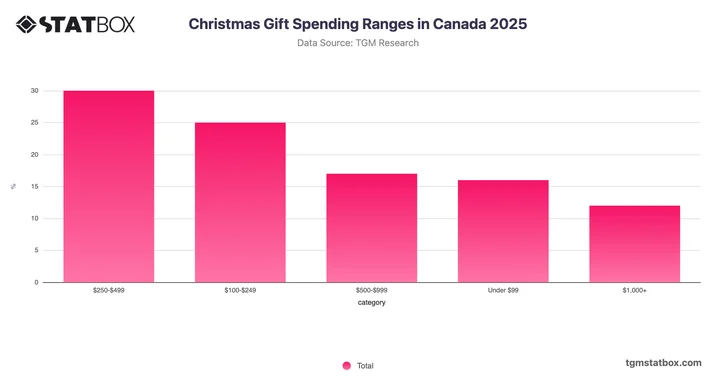
Discounting alone won't win Christmas 2026, and in markets like Germany it may barely register. The stronger play is to justify the price: make quality visible through materials, durability, reviews and guarantees. Build offers around the real budget bands in each market, such as a strong under-$100 range for Italy and a premium tier for Canada, rather than one global price point.
Get a deeper perspective on the numbers: Read more about holiday shopping behavior 2026 and what different age groups value.
The shifting patterns across global markets point to a clear reality: brands cannot rely on a one-size-fits-all playbook or wait until December to capture festive demand. To win Christmas 2026, marketing and brand strategy teams should focus on three core shifts:
New to StatBox? Create your free TGM StatBox account to save charts to Favorites and get insights like these every week.
Planning for Christmas 2026? TGM data from 6 markets shows price sways 66-76% of shoppers, clothing tops gift lists and buying starts early.
The findings presented in this report are drawn from TGM Research’s Christmas Consumer Insights 2025 study in Italy, France, Spain, the USA, Germany, and Canada, examining consumer attitudes, holiday shopping preferences, and spending habits.
The study provides insights into multi-country consumers’ Christmas shopping behaviors, gift preferences, spending plans, and key factors influencing their holiday purchasing decisions.
Findings from our data, highlighting consumer behaviour, preferences, and market signals across global markets.
Follow global economic trends and market signals through clear visual stories.
The latest launches and updates from TGM StatBox.
TGM StatBox's data and infographics across Global markets.
Consumer insights, data stories and product updates as we publish them. No other mail, and one click to leave.
Roughly two emails a month.
Our team can run the study behind the story — in 60+ countries, on your question, with the data belonging to you.
Type at least two characters to search.